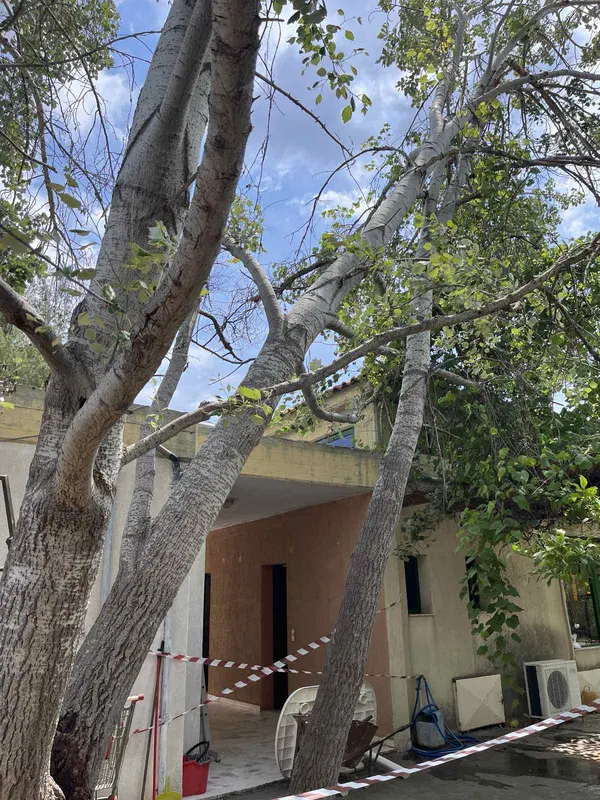
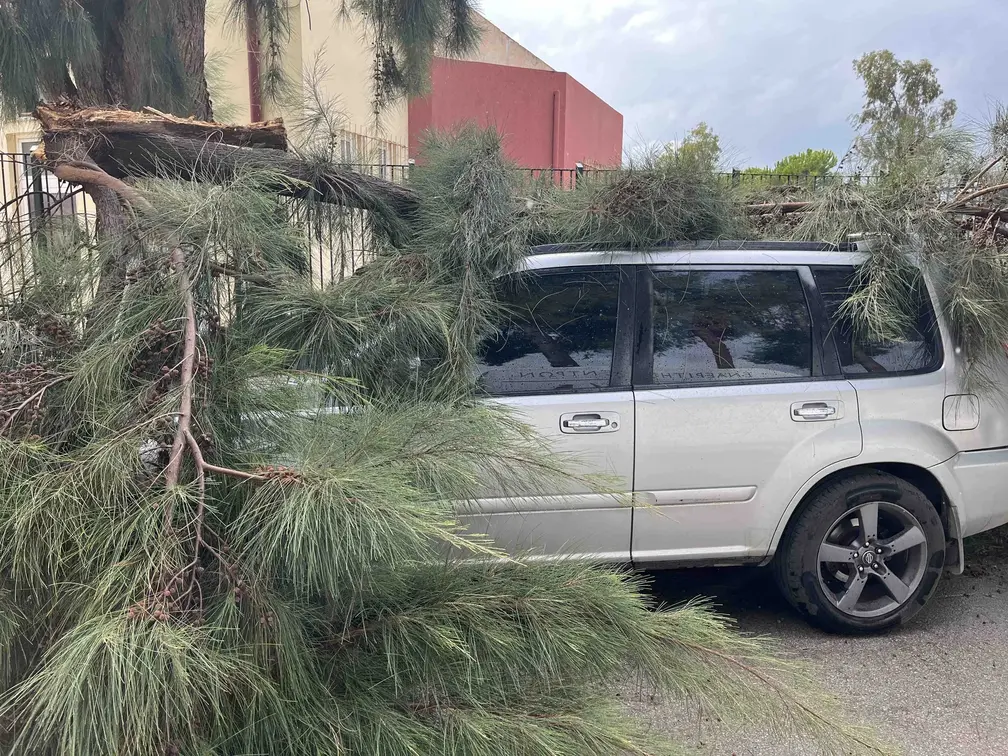
Most trees that fall do not fall “suddenly”. They usually showed signs for months or years that nobody noticed. After every strong wind in Evia we see fallen pines on cars, fences and roofs. Here are the signs worth checking on the trees near your home.
The 9 warning signs
- A new or growing lean. A tree that has always leaned and has “corrected” its top upwards is usually stable. Worrying is a lean that appeared recently or is getting worse, especially after a storm.
- Raised or cracked soil at the base. If on the side opposite the lean the ground has heaved or cracked, the roots are moving. This is one of the most serious signs.
- Cracks in the trunk or main limbs. Deep vertical or horizontal cracks show the wood has already given way, and decay often gets in there.
- Fungi at the base or on the trunk. Mushrooms and brackets are often the visible part of decay eating the wood from inside.
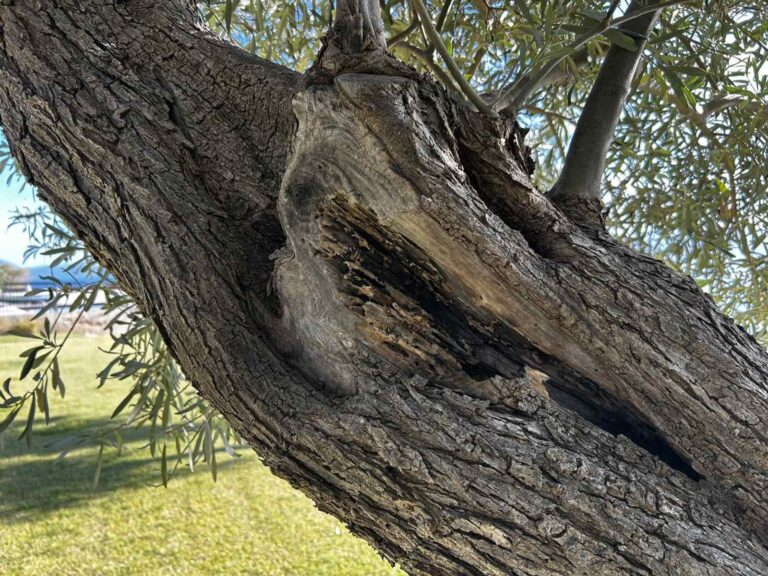
- Cavities and rotten wood. A hollow tree is not always dangerous. It depends on how much sound wood remains around the cavity, and that needs checking.
- Weak forks. Two stems forming a tight “V” with bark trapped between them break more easily than a “U”-shaped fork.
- Large dead or hanging branches. Dead branches fall even without wind. A broken branch hanging in the crown is an immediate danger.
- Cut or rotten roots. Digging for pipes, a pool, fencing or a road near the trunk can sever the roots that hold the tree, and it may fall years later.
- Dieback and insects. Thinning or yellowing foliage, browning needles, holes and sawdust on the trunk. In palms, a collapsing crown can mean red palm weevil.


A sign matters together with what lies beneath
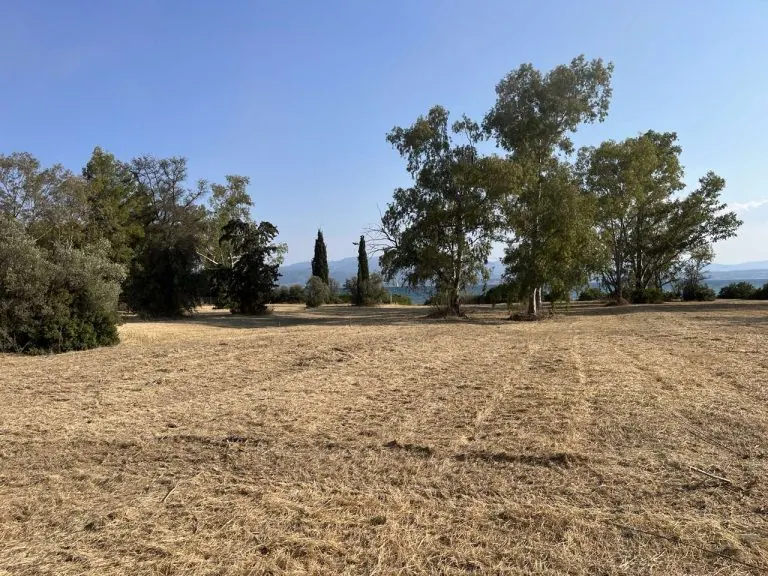
Risk is not only about the tree’s defect but about what it would hit if it fell. A rotten pine in the middle of a field is a smaller risk than a slightly leaning tree over a bedroom, a playground or a hotel car park. That is why a professional assessment also looks at “targets”: house, pool, road, power lines, places where people sit.
What to do if you see a sign
- Do not climb the tree or try to cut large branches yourself. Most chainsaw accidents happen this way.
- Photograph the sign and note whether it changes (e.g. the lean increases).
- Keep people and cars out of the fall zone until the tree is checked.
- Ask for a professional assessment. The answer is not always felling: often a pruning that lightens the crown, or removing one branch, is enough.
- If the tree is on a pavement or public land, inform the municipality. If felling is needed, see when a permit is required.
Emergency: if a tree has fallen or is hanging on power lines, stay away. Call 112 or the Fire Service (199) and the grid operator HEDNO.
When to check your trees
- After strong wind, snow or a fire.
- Before any digging near the roots.
- When buying or renting a property with large trees.
- Once a year for hotels, schools, camps and busy places.
For a first impression, try the quick check on our home page.
Need a tree risk assessment? See our service or ask for a free site visit.