
Every year, before summer, owners of plots in and around Greek towns and villages must clear them of dry grass, branches and anything else that can catch fire. Since 2026 the clearing must also be declared online. The rules are set by Joint Ministerial Decision YP 1157/2026 (Government Gazette B’ 2323/24-04-2026), which applies “every year”, so in 2027 too unless a new decision is issued. Here is what it says, in plain words.
Who it applies to
The obligation covers plots and open spaces:
- inside an approved town plan;
- inside the boundaries of villages without a town plan;
- up to 100 metres from the edge of a town plan or village, unless the land is classified as forest;
- outside the town plan where there is a building, unless the land is classified as forest.
The duty is not only the owner’s. It falls on whoever uses the land, e.g. a tenant or usufructuary, and if there are several, they are jointly liable. Exempt are, among others, cultivated farmland (including fallow land), grazing land, maintained gardens and areas that are provably inaccessible.
What must be done
The decision lists specific work:
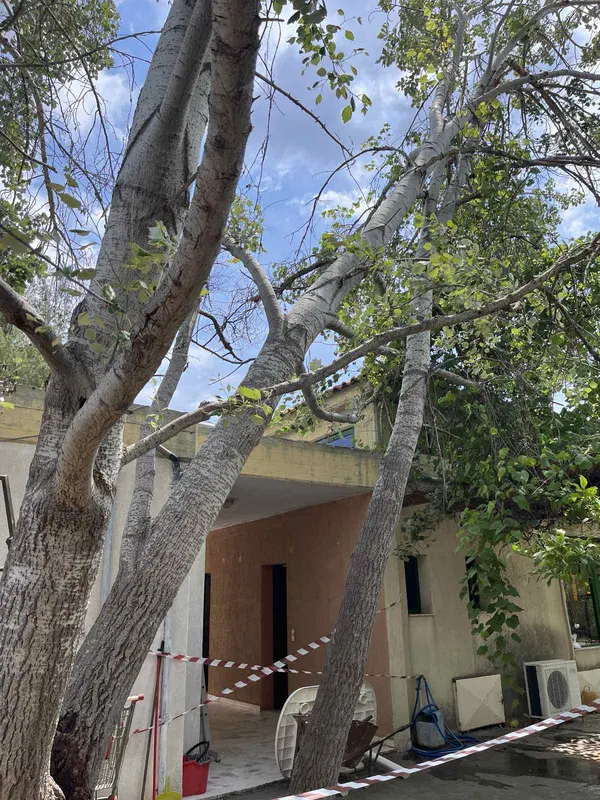
- cutting and removing dead or broken trees and branches, and branches touching a building;
- removing dry vegetation: dry grass, reeds, pine needles and dead leaves;
- pruning the lower branches of trees so the crown starts higher, depending on species and age;
- thinning shrubs so there are gaps between them;
- removing flammable materials and rubbish: petrol and solvent cans, gas bottles, ammonium nitrate fertilisers, old furniture, mattresses, tyres.
Cut grass and branches must not be left in piles on the plot. They are removed under your municipality’s cleaning rules, which name drop-off points (e.g. brown bins or recycling centres).


Deadlines
- 1 April – 15 June: clear the land.
- By 15 June: submit a declaration that the clearing was done.
- Until 31 October: keep the land clear.
- 16 June – 31 October: inspections by the municipality (random, at least 5% of declarations) and by the Fire Service, mainly after complaints.
Do not leave it until June. In Evia and Attica demand for clearing peaks in May, and grass dries out fast.
The online declaration
The declaration is made on akatharista.apps.gov.gr (the national register of fire-prevention measures for properties). Paper declarations are allowed only in specific cases: if the platform is down, for people over 67, for people with disabilities or in case of force majeure. Note: if the deadline passes without a declaration, the law treats it as consent for the municipality to clear the plot at your expense.
Fines
- Not clearing, or clearing badly: €1 per square metre, minimum €200, maximum €2,000.
- No declaration: €500 if the land was not cleared, €100 if it was cleared but not declared.
- False declaration: a €5,000 fine and at least 6 months’ imprisonment.
- Clearing by the municipality: the cost of the clearing and of removing the material is charged to the person responsible.
You can object within 10 days of being notified. If you clear the land within that period, the fine is reduced by 50%.
Practical tips
- Keep dated before-and-after photos in case of an inspection.
- If your plot borders pine woods or forest, do more than the minimum: a zone free of dry vegetation around the house is the best protection.
- Clearing does not end in June. Grass grows back, so a second pass in early summer is often needed.
- If you live elsewhere (holiday home, owners abroad), arrange for someone to do it in good time and send you photos.
You can read the decision (in Greek) here (YP 1157/2026). This information is current as of November 2026. If a new decision for 2027 changes the dates or amounts, we will update this article.
Need your plot cleared before the deadline? See our service or ask for a free site visit.